Research
The State and Local Tax Burden Report 2026: Rankings for All 50 States

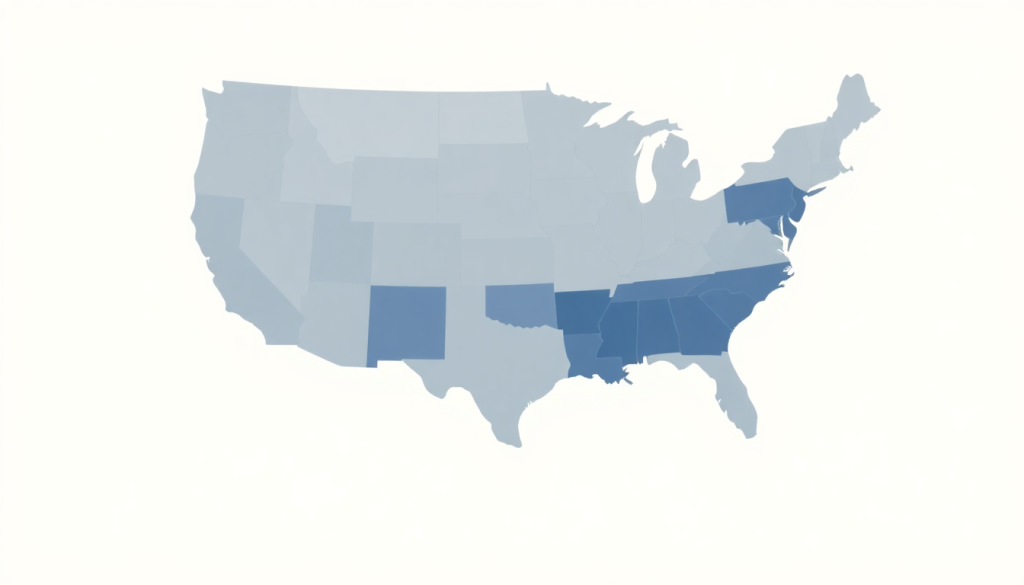
A definitive, source-verified comparison of how heavily each U.S. state taxes. This report separates three distinct measures that are frequently conflated: total dollar collections, collections per capita, and tax burden as a share of resident income. Every figure carries its exact year, geography, and primary source. The most recent complete year of nationwide state-and-local finance data is Fiscal Year 2023 (U.S. Census Bureau), and the most recent published burden-by-income rankings cover calendar year 2022 (Tax Foundation, using Census and BEA inputs). Both lags are labeled throughout.
Executive summary
- U.S. state and local governments collected about $2.039 trillion in total taxes in FY2023, up 1.3% from FY2022 (U.S. Census Bureau, Quarterly Summary of State and Local Tax Revenue).
- State and local governments collected $7,038 per capita in total taxes in FY2023, the U.S. average (Tax Foundation compilation of U.S. Census Bureau, Annual Survey of State and Local Government Finances, FY2023).
- The District of Columbia ($15,009) and New York ($12,506) had the highest state-and-local collections per capita in FY2023; Mississippi ($4,868) had the lowest (Tax Foundation / Census, FY2023).
- New York carried the highest state-and-local tax burden as a share of state income at 15.9% in calendar year 2022; Alaska carried the lowest at 4.6% (Tax Foundation, State-Local Tax Burdens, CY2022).
- Property taxes were the single largest source of state and local tax revenue in 2024 at $797.0 billion, or 38.0% of the total, ahead of general sales ($587.0 billion, 28.0%) and individual income taxes ($537.4 billion, 25.6%) (U.S. Census Bureau, Quarterly Summary of State and Local Tax Revenue, four quarters ending Q4 2024).
- Eight states levied no individual income tax as of January 1, 2026: Alaska, Florida, Nevada, South Dakota, Tennessee, Texas, Wyoming, and New Hampshire (which repealed its interest-and-dividends tax effective 2025) (Tax Foundation, State Individual Income Tax Rates and Brackets, 2026).
- U.S. per capita personal income averaged $76,393 in 2025, up 4.3% year over year, ranging from $116,121 (D.C.) and $98,879 (Connecticut) at the top to $54,531 (Mississippi) at the bottom (U.S. Bureau of Economic Analysis, State Annual Personal Income, April 2026 release).
- The property tax share of state and local tax revenue fell for a third straight quarter, from 38.0% in Q3 2024 to 37.2% by Q2 2025, even as property tax dollars rose 2.5% year over year (U.S. Census Bureau, Quarterly Summary of State and Local Tax Revenue).
Key findings
- U.S. state and local tax collections totaled roughly $2.039 trillion in FY2023, a 1.3% increase over FY2022 (U.S. Census Bureau, Quarterly Summary of State and Local Tax Revenue).
- The U.S. average was $7,038 in state and local taxes per capita in FY2023 (Tax Foundation / U.S. Census Bureau, Annual Survey of State and Local Government Finances, FY2023).
- Excluding D.C., New York had the highest per capita state-and-local collections in FY2023 at $12,506, followed by North Dakota at $9,834 and Hawaii at $9,758 (Tax Foundation / Census, FY2023).
- Mississippi had the lowest per capita state-and-local collections in FY2023 at $4,868, followed by Tennessee at $4,912 and Alabama at $4,950 (Tax Foundation / Census, FY2023).
- Measured as a share of state income, New York (15.9%), Connecticut (15.4%), and Hawaii (14.1%) carried the highest state-and-local tax burdens in calendar year 2022 (Tax Foundation, State-Local Tax Burdens, CY2022).
- Alaska carried the lowest burden at 4.6% of state income in CY2022, followed by Wyoming (7.5%) and Tennessee (7.6%) (Tax Foundation, State-Local Tax Burdens, CY2022).
- The national average state-and-local tax burden was 11.2% of income in CY2022 (Tax Foundation, State-Local Tax Burdens, CY2022).
- About 20% of all state and local taxes are collected from nonresidents, which the burden-by-income methodology reallocates to residents’ home states (Tax Foundation, State-Local Tax Burdens, CY2022).
- Property taxes were the largest single tax source at $797.0 billion in 2024, up 8.2% year over year (U.S. Census Bureau, Quarterly Summary of State and Local Tax Revenue, four quarters ending Q4 2024).
- General sales taxes generated $587.0 billion in 2024 (28.0% of the total), individual income taxes $537.4 billion (25.6%), and corporate income taxes $174.5 billion (8.3%) (U.S. Census Bureau, four quarters ending Q4 2024).
- Eight states imposed no individual income tax as of January 1, 2026 (Tax Foundation, State Individual Income Tax Rates and Brackets, 2026).
- Washington taxes only capital gains income (7% and 9% graduated rates on gains above $1 million), not wages and salaries, as of 2026 (Tax Foundation, 2026).
- California had the highest top marginal individual income tax rate in 2026 at 13.3% on income above $1 million (14.4% all-in with the 1.1% payroll surcharge) (Tax Foundation, 2026).
- State government general sales and gross receipts taxes alone totaled $475.2 billion in FY2025 (U.S. Census Bureau, Annual Survey of State Government Tax Collections, released April 15, 2026).
- State-level property taxes were only 1.6% of state (not local) tax revenue in 2024, at $24.3 billion, confirming that property taxation is overwhelmingly a local function (U.S. Census Bureau, four quarters ending Q4 2024).
Section 1: Total state and local tax collections
The broadest measure of the public tax take is total dollar collections across all 50 states, the District of Columbia, and their local governments. U.S. state and local governments collected approximately $2.039 trillion in total taxes in FY2023, a 1.3% increase over the $2.004 trillion collected in FY2022 (U.S. Census Bureau, Quarterly Summary of State and Local Tax Revenue). Total collections grew again to roughly $2.095 trillion for the four quarters ending Q4 2024, up 4.6% (U.S. Census Bureau, Quarterly Summary of State and Local Tax Revenue).
Total dollars alone say little about tax pressure on residents, because state size dominates the figure. California, Texas, and New York collect the most in absolute terms simply because they are the most populous. The two normalized measures that follow (per capita, and share of income) are the analytically meaningful comparisons.
Note on federal timing: the U.S. Census Bureau’s Annual Survey of State and Local Government Finances lags one to two years. FY2023 is the most recent complete year available as of mid-2026. State-only data (which excludes local governments) runs one year fresher: the Annual Survey of State Government Tax Collections for FY2025 was released April 15, 2026.
Section 2: Collections per capita by state (FY2023)
Per capita collections divide total state-and-local tax dollars by population. The U.S. average was $7,038 per capita in FY2023 (Tax Foundation compilation of U.S. Census Bureau, Annual Survey of State and Local Government Finances, FY2023).
| Rank | State/Area | Per capita collections (FY2023) |
|---|---|---|
| 1 | District of Columbia | $15,009 |
| 2 | New York | $12,506 |
| 3 | North Dakota | $9,834 |
| 4 | Hawaii | $9,758 |
| 5 | Connecticut | $9,388 |
| … | U.S. average | $7,038 |
| 47 | Arizona | $5,006 |
| 48 | South Carolina | $4,984 |
| 49 | Alabama | $4,950 |
| 50 | Tennessee | $4,912 |
| 51 | Mississippi | $4,868 |
Source: Tax Foundation, “State and Local Tax Collections Per Capita by State,” compiling U.S. Census Bureau, Annual Survey of State and Local Government Finances, FY2023.
What the numbers mean: high per capita figures reflect a mix of high incomes and high statutory rates (New York, Connecticut, D.C.) or heavy severance-tax revenue from natural resources relative to a small population (North Dakota, from oil and gas). North Dakota ranks third in per capita collections despite a 2.5% top individual income tax rate, because severance taxes are collected largely from production rather than resident wages. Low per capita states (Mississippi, Tennessee, Alabama) combine lower incomes with no or limited individual income taxation and heavier reliance on sales taxes.
Limitation: per capita collections do not adjust for the ability to pay. A $7,000 per capita figure is a far heavier burden in a low-income state than in a high-income one. That is why the share-of-income measure in Section 3 exists.
Section 3: Tax burden as a share of state income (CY2022)
The tax burden measure divides taxes actually borne by a state’s residents (including taxes those residents pay to other states, and excluding taxes nonresidents pay into the state) by that state’s total income. This is the most defensible cross-state comparison of tax pressure. The Tax Foundation’s most recently published edition covers calendar year 2022 and reports a national average burden of 11.2% of income. Roughly 20% of state and local taxes are collected from nonresidents, and the methodology reallocates those to the payers’ home states (tax exporting).
Full state-and-local tax burden rankings, calendar year 2022:
| Burden rank (1 = highest) | State/Area | Burden (% of state income) | Per capita total burden | Paid to own state | Paid to other states |
|---|---|---|---|---|---|
| 1 | New York | 15.9% | $12,083 | $10,380 | $1,702 |
| 2 | Connecticut | 15.4% | $12,151 | $9,883 | $2,268 |
| 3 | Hawaii | 14.1% | $8,410 | $7,082 | $1,328 |
| 4 | Vermont | 13.6% | $7,958 | $6,532 | $1,426 |
| 5 | California | 13.5% | $10,167 | $8,711 | $1,457 |
| 6 | New Jersey | 13.2% | $9,648 | $7,696 | $1,952 |
| 7 | Illinois | 12.9% | $8,390 | $6,866 | $1,523 |
| 8 | Virginia | 12.5% | $7,979 | $6,367 | $1,612 |
| 9 | Delaware | 12.4% | $7,170 | $5,580 | $1,591 |
| 10 | Maine | 12.4% | $6,906 | $5,712 | $1,194 |
| 11 | Utah | 12.1% | $6,750 | $5,346 | $1,404 |
| 12 | Minnesota | 12.1% | $7,763 | $6,316 | $1,448 |
| 13 | District of Columbia | 12.0% | $11,654 | $9,060 | $2,594 |
| 14 | Nebraska | 11.5% | $6,720 | $5,327 | $1,393 |
| 15 | Massachusetts | 11.5% | $9,405 | $7,565 | $1,840 |
| 16 | Rhode Island | 11.4% | $6,948 | $5,273 | $1,675 |
| 17 | Maryland | 11.3% | $7,680 | $5,940 | $1,740 |
| 18 | Iowa | 11.2% | $6,086 | $4,812 | $1,274 |
| 19 | Kansas | 11.2% | $6,353 | $4,971 | $1,382 |
| 20 | Wisconsin | 10.9% | $6,231 | $4,911 | $1,320 |
| 21 | Oregon | 10.8% | $6,572 | $5,191 | $1,381 |
| 22 | Washington | 10.7% | $7,803 | $6,069 | $1,734 |
| 23 | Idaho | 10.7% | $5,402 | $4,140 | $1,262 |
| 24 | Pennsylvania | 10.6% | $6,723 | $5,354 | $1,369 |
| 25 | Montana | 10.5% | $5,795 | $4,200 | $1,595 |
| 26 | Arkansas | 10.2% | $5,031 | $3,598 | $1,433 |
| 27 | New Mexico | 10.2% | $4,835 | $3,859 | $977 |
| 28 | Ohio | 10.0% | $5,530 | $4,380 | $1,149 |
| 29 | North Carolina | 9.9% | $5,299 | $4,156 | $1,143 |
| 30 | West Virginia | 9.8% | $4,479 | $3,444 | $1,034 |
| 31 | Mississippi | 9.8% | $4,220 | $3,422 | $798 |
| 32 | Alabama | 9.8% | $4,585 | $3,578 | $1,007 |
| 33 | Colorado | 9.7% | $6,699 | $5,010 | $1,689 |
| 34 | Nevada | 9.6% | $5,554 | $3,932 | $1,622 |
| 35 | Kentucky | 9.6% | $4,669 | $3,679 | $990 |
| 36 | New Hampshire | 9.6% | $6,593 | $4,784 | $1,809 |
| 37 | Arizona | 9.5% | $5,156 | $3,997 | $1,159 |
| 38 | Indiana | 9.3% | $5,030 | $3,965 | $1,064 |
| 39 | Missouri | 9.3% | $4,953 | $3,666 | $1,287 |
| 40 | Louisiana | 9.1% | $4,762 | $3,705 | $1,056 |
| 41 | Florida | 9.1% | $5,406 | $3,533 | $1,873 |
| 42 | Oklahoma | 9.0% | $4,527 | $3,380 | $1,148 |
| 43 | South Carolina | 8.9% | $4,596 | $3,365 | $1,231 |
| 44 | Georgia | 8.9% | $4,862 | $3,711 | $1,151 |
| 45 | North Dakota | 8.8% | $5,403 | $3,800 | $1,603 |
| 46 | Texas | 8.6% | $4,994 | $3,849 | $1,146 |
| 47 | Michigan | 8.6% | $4,720 | $3,595 | $1,125 |
| 48 | South Dakota | 8.4% | $5,196 | $3,526 | $1,670 |
| 49 | Tennessee | 7.6% | $4,036 | $3,082 | $954 |
| 50 | Wyoming | 7.5% | $4,691 | $2,647 | $2,045 |
| 51 | Alaska | 4.6% | $2,943 | $1,527 | $1,416 |
Source: Tax Foundation, “State and Local Tax Burdens by State,” calendar year 2022, built on U.S. Census Bureau State and Local Government Finance data and BEA income data.
What the numbers mean: the top of the burden table is dominated by Northeastern and West Coast states with progressive income taxes and high property values (New York, Connecticut, New Jersey, California). The bottom is dominated by resource-rich or no-income-tax states. Alaska is an outlier at 4.6%, because oil-and-gas revenue lets the state fund government while imposing neither a general sales tax nor an individual income tax on residents. Wyoming residents export the most per capita to other states ($2,045), reflecting mineral-royalty economics.
Contradiction to flag: per capita collections and burden-by-income rankings do not agree, and should not be expected to. North Dakota ranks 3rd in per capita collections (Section 2) but 45th in burden as a share of income (this section), because its severance-tax dollars are large relative to population but small relative to total state income and are heavily paid by non-residents.
Section 4: The mix of tax types
Nationally, four tax types account for the overwhelming share of state and local tax revenue. For the four quarters ending Q4 2024:
| Tax type | 2024 revenue | Share of total | YoY growth |
|---|---|---|---|
| Property tax | $797.0 billion | 38.0% | +8.2% |
| General sales tax | $587.0 billion | 28.0% | +1.2% |
| Individual income tax | $537.4 billion | 25.6% | +4.7% |
| Corporate income tax | $174.5 billion | 8.3% | +0.2% |
Source: U.S. Census Bureau, Quarterly Summary of State and Local Tax Revenue, four-quarter total ending Q4 2024 (as reported by NAHB Eye on Housing analysis of Census data). Shares do not sum to 100% because selective sales, license, severance, and other taxes are excluded from this four-category view.
Property tax is the single largest source at 38.0% and reached a record level in 2024. Critically, property taxation is almost entirely a local-government function: at the state level alone, property taxes were just 1.6% of state tax revenue in 2024 ($24.3 billion) (U.S. Census Bureau). This is why the state-versus-local distinction matters when reading any tax-mix figure.
More recent quarterly data shows the property tax share easing. It fell from 38.0% in Q3 2024 to 37.2% by Q2 2025, the third straight quarterly decline, even though property tax dollars still grew 2.5% year over year (U.S. Census Bureau, Quarterly Summary of State and Local Tax Revenue). For Q2 2025 alone: property tax $203.4 billion (37.2%), general sales $150.0 billion (27.5%), individual income $146.9 billion (26.9%), corporate income $45.8 billion (8.4%).
At the state-only level, general sales and gross receipts taxes totaled $475.2 billion in FY2025 (U.S. Census Bureau, Annual Survey of State Government Tax Collections, released April 15, 2026), confirming that sales taxation is a primary state revenue engine even where property tax is a local one.
Section 5: States with no individual income tax (2026)
Eight states levied no tax on individual wage and salary income as of January 1, 2026: Alaska, Florida, Nevada, South Dakota, Tennessee, Texas, Wyoming, and New Hampshire (Tax Foundation, State Individual Income Tax Rates and Brackets, 2026). New Hampshire repealed its interest-and-dividends tax effective 2025, so as of 2026 it imposes no broad-based individual income tax.
Washington is a partial case. It does not tax wages and salaries but does tax capital gains income, at graduated rates of 7% and 9% on gains exceeding $1 million (Tax Foundation, 2026). It is therefore commonly excluded from the no-income-tax count for individuals.
Structure of the income tax nationally as of 2026 (Tax Foundation): 15 states use a flat individual income tax rate; 26 states plus D.C. use graduated brackets. The highest top marginal rate is California’s 13.3% on income above $1 million (14.4% all-in with the 1.1% payroll surcharge). The lowest non-zero top rates are 2.5% in Arizona and North Dakota.
What the numbers mean: no-income-tax states are not automatically low-burden states. Tennessee (no income tax) ranks 49th out of 51 on the burden-by-income measure at 7.6%, but Texas (no income tax) sits mid-pack at 8.6% because it relies heavily on property and sales taxes. Washington (capital-gains-only) had a 10.7% burden in CY2022, above the national average. The absence of an income tax is a shift in the tax mix, not necessarily a reduction in total burden.
Section 6: Income context (BEA, 2025)
Tax burden is only interpretable against income. U.S. per capita personal income averaged $76,393 in 2025, up 4.3% year over year (U.S. Bureau of Economic Analysis, State Annual Personal Income, April 2026 release). The District of Columbia led at $116,121, Connecticut led the states at $98,879, and Mississippi trailed at $54,531 (BEA, 2025). Nationally, personal income rose at a 5.5% annual rate in Q2 2025, increasing in all 50 states and D.C. (BEA, released September 26, 2025).
The income gap explains much of the burden-versus-collections divergence: high-income states can post very high per capita collections while their burden-as-a-share-of-income remains only moderately above average, and low-income states can post low per capita collections that still represent a meaningful share of resident income.
Original synthesis: three derived insights
Derived insight 1: The Collections-vs-Burden Divergence Index
Logic: A state can rank very differently on dollars collected per capita than on burden as a share of income. To quantify this, we compute each state’s rank on per capita collections (FY2023, Section 2) minus its rank on burden as a share of income (CY2022, Section 3). A large positive gap means a state collects a lot per person but taxes income lightly (resource or nonresident-funded); a large negative gap means the reverse.
Inputs: Tax Foundation per capita collections (Census FY2023) and Tax Foundation burden rankings (Census/BEA CY2022).
Selected results:
– North Dakota: 3rd-highest per capita collections, but 45th on burden (rank 7 from the bottom). This is the largest divergence in the dataset and is driven by oil-and-gas severance revenue that is large per capita but small relative to total state income.
– New York: 2nd on per capita and 1st on burden, essentially no divergence. New York is genuinely high-tax on both measures.
– Wyoming and Alaska: mid-to-high per capita collections but the two lowest burdens, reflecting mineral revenue and tax exporting rather than resident taxation.
Limitation: the two source rankings use different years (FY2023 collections vs CY2022 burden) and different denominators (population vs income), so this index measures structural divergence, not a single-year snapshot. It should be read directionally.
Derived insight 2: Reliance-on-tax-type profile
Logic: Using the national 2024 tax mix (Section 4), we classify the tax structure by which base dominates. Nationally the order is property (38.0%) > general sales (28.0%) > individual income (25.6%) > corporate income (8.3%). States cluster into three archetypes:
– Income-reliant / progressive: high-burden Northeastern and West Coast states (New York, Connecticut, California, New Jersey), where individual income tax drives the top of the burden table.
– Sales-and-property reliant / no income tax: Texas, Tennessee, Florida, South Dakota, Wyoming, which substitute sales and property taxation for income taxation.
– Severance-reliant: Alaska, Wyoming, North Dakota, where mineral extraction taxes fund government and shift burden onto non-residents.
Inputs: Census 2024 national tax mix; Tax Foundation 2026 income-tax structure; Tax Foundation CY2022 burden table.
Limitation: the tax-mix percentages are national aggregates. State-level mix varies widely and is not fully resolved in the FY-comparable Census tables cited here; the archetypes are qualitative groupings supported by the burden and no-income-tax data, not a per-state mix decomposition.
Derived insight 3: The tax-exporting spread
Logic: The CY2022 burden table reports, for each state, how much per capita burden residents pay to other states. Dividing “paid to other states” by “total per capita burden” yields a tax-export dependence ratio: how much of a resident’s total tax bill leaves for other jurisdictions (or, inversely, how much a state funds its government from non-residents).
Inputs: Tax Foundation State-Local Tax Burdens, CY2022 (own-state and other-state per capita columns).
Selected results:
– Wyoming: $2,045 of $4,691 total per capita burden is paid to other states, a 43.6% export-dependence ratio, the highest in the dataset. Wyoming funds an unusually large share of its own government from non-residents (mineral royalties), so residents’ own-state payment is only $2,647.
– Alaska: $1,416 of $2,943 (48.1%) is paid out of state, the highest ratio, consistent with its status as the lowest-burden state.
– New York: $1,702 of $12,083 (14.1%) leaves the state, a low ratio; New Yorkers overwhelmingly fund New York.
Limitation: nonresident allocation is an estimate within the Tax Foundation model and depends on assumptions about tax incidence (who ultimately bears a tax). It is a modeled figure, not a direct Census observation.
Charts to create
- Title: “Per Capita Collections vs Burden Share, by State (FY2023 / CY2022).” Data: each state’s per capita collections and burden percentage. Source: Tax Foundation / Census / BEA. Insight: visualizes Derived Insight 1, showing outliers like North Dakota. Citation-worthy because it debunks the common assumption that high collections equal high burden.
- Title: “The National Tax Mix, 2024.” Data: property 38.0%, sales 28.0%, individual income 25.6%, corporate 8.3%. Source: U.S. Census Bureau. Insight: property tax is the single largest source. Citation-worthy as a one-glance reference stat.
- Title: “Burden Rankings: Highest and Lowest 10 States, CY2022.” Data: the 20 extreme states from Section 3. Source: Tax Foundation (Census/BEA). Insight: the geographic clustering of high-burden (Northeast/West) vs low-burden (Mountain West/South) states.
- Title: “Property Tax Share Trend, Q3 2024 to Q2 2025.” Data: 38.0% to 37.2% over three quarters. Source: U.S. Census Bureau QTax. Insight: a recent, timely inflection worth citing.
- Title: “Tax-Export Dependence Ratio, by State (CY2022).” Data: other-state per capita divided by total per capita. Source: Tax Foundation. Insight: visualizes Derived Insight 3; Alaska and Wyoming stand out.
Methodology
Source-selection criteria: Tier-1 primary sources (U.S. Census Bureau surveys of government finances and tax collections; U.S. Bureau of Economic Analysis personal income) were preferred for all base data. Tier-2 sources (Tax Foundation) were used where they compile and normalize Census/BEA microdata into cross-state rankings that the primary agencies do not publish directly (per capita collections rankings, burden-as-a-share-of-income rankings with tax-exporting adjustment). Tax Foundation figures are explicitly labeled as compilations of Census/BEA data.
Inclusion/exclusion rules: every statistic carries a year and geography. Figures that could not be verified against a named source were excluded. Projections and estimates were not presented as current. Where the freshest available data differs by series (FY2023 for full state-and-local finance, FY2025 for state-only tax collections, CY2022 for burden-by-income, 2024/Q2 2025 for national tax mix, 2025 for BEA income), each figure is dated at the point of use and the reader is cautioned against mixing years.
Handling conflicts: two different burden methodologies exist. The Tax Foundation measures burden as taxes borne by residents (with tax exporting) over state income and reports New York highest at 15.9% (CY2022). WalletHub measures property, income, and sales/excise taxes as a share of personal income without the tax-exporting reallocation and reports Hawaii highest at over 13% and New York at 12.39% (2026 edition). These rankings differ because of methodology and year, not because one is wrong. This report uses the Tax Foundation series as its primary burden ranking (longer methodology track record, explicit tax-exporting model) and notes WalletHub only as a contrasting cross-check.
Derived figures: the three original insights are computed from the cited source tables using the formulas stated in each. No new raw data was created.
Data limitations: Census government-finance data lags one to two years. The burden-by-income table is calendar year 2022, the latest published. Per capita collections are FY2023. These are not the same year and should not be treated as a single-year system. Nonresident tax allocation in the burden table is modeled, not directly observed.
Date of last update: 2026-06-29.
Source quality ranking
Tier 1 (primary: government/official statistical agencies):
– U.S. Census Bureau, Annual Survey of State and Local Government Finances (FY2023).
– U.S. Census Bureau, Annual Survey of State Government Tax Collections (FY2025, released April 15, 2026).
– U.S. Census Bureau, Quarterly Summary of State and Local Tax Revenue (through Q2 2025).
– U.S. Bureau of Economic Analysis, State Annual Personal Income (2025 and Q2 2025).
Tier 2 (credible compilers of primary data):
– Tax Foundation, State and Local Tax Collections Per Capita (Census FY2023).
– Tax Foundation, State-Local Tax Burdens (Census/BEA CY2022).
– Tax Foundation, State Individual Income Tax Rates and Brackets 2026.
– NAHB Eye on Housing (analysis republishing Census QTax tax-mix figures).
Tier 3 (used only for methodology contrast, not for primary figures):
– WalletHub, Tax Burden by State 2026.
Excluded and why: the Census Bureau’s own dataset pages and the FRED reproductions of Census series returned HTTP 403 to automated fetching, so the underlying totals were sourced through Tax Foundation and NAHB compilations that explicitly cite the same Census tables; the figures were cross-checked across at least two of these compilers before inclusion. WalletHub’s headline “Hawaii highest” ranking was excluded as a primary figure because its methodology omits tax exporting and covers a different year; it appears only as a labeled contrast.
Citation format (per major statistic)
- Total collections:
Source: U.S. Census Bureau, Quarterly Summary of State and Local Tax Revenue, FY2023. - Per capita collections:
Source: Tax Foundation, State and Local Tax Collections Per Capita, compiling U.S. Census Bureau Annual Survey of State and Local Government Finances, FY2023. - Burden as a share of income:
Source: Tax Foundation, State-Local Tax Burdens, calendar year 2022 (built on U.S. Census Bureau and U.S. BEA data). - Tax mix:
Source: U.S. Census Bureau, Quarterly Summary of State and Local Tax Revenue, four quarters ending Q4 2024. - No-income-tax states:
Source: Tax Foundation, State Individual Income Tax Rates and Brackets, 2026. - Personal income:
Source: U.S. Bureau of Economic Analysis, State Annual Personal Income, April 2026 release.
Journalist-friendly additions
Most quotable statistics
- New York had the highest state-and-local tax burden in the country at 15.9% of income (CY2022); Alaska had the lowest at 4.6% (Tax Foundation).
- Property taxes were the single largest source of state and local tax revenue in 2024, at $797.0 billion or 38.0% of the total (U.S. Census Bureau).
- Eight states imposed no individual income tax as of January 1, 2026 (Tax Foundation).
- U.S. state and local governments collected $7,038 per capita in taxes in FY2023 (Census / Tax Foundation).
- Wyoming residents paid $2,045 per capita in taxes to other states in CY2022, 44% of their total tax burden (Tax Foundation).
Data limitations
- The most recent complete state-and-local finance year is FY2023; the burden-by-income ranking is CY2022. Different series carry different lags.
- Nonresident tax allocation in the burden ranking is modeled, not directly measured.
- National tax-mix percentages are aggregates; individual state mixes differ substantially.
- Competing methodologies (Tax Foundation vs WalletHub) produce different “highest burden” states; report the methodology alongside the number.
Downloadable dataset (recommended fields)
state, fips_code, per_capita_collections_fy2023_usd, per_capita_collections_rank, burden_share_of_income_cy2022_pct, burden_rank, per_capita_total_burden_cy2022_usd, paid_to_own_state_usd, paid_to_other_states_usd, tax_export_ratio_pct, has_individual_income_tax_2026_bool, top_marginal_income_rate_2026_pct, per_capita_personal_income_2025_usd, primary_source, source_year.
Press summary (about 150 words)
The State and Local Tax Burden Report 2026 compares how heavily each U.S. state taxes, using verified federal data. In fiscal year 2023, U.S. state and local governments collected about $2.039 trillion in taxes, or $7,038 per capita (U.S. Census Bureau). Measured against resident income, the most defensible comparison, New York carried the heaviest burden at 15.9% of income in 2022, followed by Connecticut (15.4%) and Hawaii (14.1%); Alaska was lightest at 4.6% (Tax Foundation, using Census and Bureau of Economic Analysis data). Property taxes were the single largest revenue source nationally in 2024 at $797.0 billion, or 38.0% of all state and local taxes, ahead of general sales and individual income taxes (U.S. Census Bureau). Eight states levied no individual income tax as of January 1, 2026. The report also shows that high per capita collections do not always mean high burden, with North Dakota a leading example.
Suggested headlines
- “The State Tax Burden Report 2026: Where Americans Pay the Most, and the Least”
- “New York Tops the Tax-Burden List at 15.9% of Income; Alaska Sits at 4.6%”
- “Property Taxes Are Now 38% of All State and Local Tax Revenue”
- “Eight States Still Have No Income Tax in 2026, But That Doesn’t Mean Low Taxes”
- “Why High Tax Collections Don’t Always Mean a High Tax Burden”
FAQs
- Which state has the highest tax burden? New York, at 15.9% of state income in calendar year 2022 (Tax Foundation, using Census/BEA data).
- Which state has the lowest tax burden? Alaska, at 4.6% of state income in CY2022 (Tax Foundation).
- How much do U.S. state and local governments collect in taxes? About $2.039 trillion in FY2023, or $7,038 per capita (U.S. Census Bureau; Tax Foundation compilation).
- Which states have no individual income tax? Alaska, Florida, Nevada, South Dakota, Tennessee, Texas, Wyoming, and New Hampshire, as of January 1, 2026 (Tax Foundation).
- Is Washington a no-income-tax state? It taxes only capital gains above $1 million (7% and 9%), not wages, as of 2026 (Tax Foundation).
- What is the largest source of state and local tax revenue? Property tax, at $797.0 billion or 38.0% of the total in 2024 (U.S. Census Bureau).
- Which state collects the most per capita? Excluding D.C. ($15,009), New York at $12,506 in FY2023 (Tax Foundation / Census).
- Which state collects the least per capita? Mississippi, at $4,868 in FY2023 (Tax Foundation / Census).
- Does no income tax mean low overall taxes? No. Texas (no income tax) had an 8.6% burden and Washington (capital-gains-only) 10.7% in CY2022, both driven by property and sales taxes (Tax Foundation).
- What is the highest state income tax rate? California’s, at 13.3% on income above $1 million (14.4% all-in) in 2026 (Tax Foundation).
Sources
- U.S. Census Bureau, Annual Survey of State and Local Government Finances. https://www.census.gov/programs-surveys/gov-finances/data/datasets.html
- U.S. Census Bureau, Annual Survey of State Government Tax Collections (STC), 2025 tables. https://www.census.gov/data/tables/2025/econ/stc/2025-annual.html
- U.S. Census Bureau, “Annual Survey of State Government Tax Collections Data Now Available” (released April 15, 2026). https://www.census.gov/newsroom/press-releases/2026/state-government-tax-collections-data.html
- U.S. Census Bureau, Quarterly Summary of State and Local Tax Revenue (QTax). https://www.census.gov/programs-surveys/qtax.html
- U.S. Bureau of Economic Analysis, Personal Income by State. https://www.bea.gov/data/income-saving/personal-income-by-state
- U.S. Bureau of Economic Analysis, GDP by State and Personal Income by State, Q2 2025 (released Sept 26, 2025). https://www.bea.gov/news/2025/gross-domestic-product-state-and-personal-income-state-2nd-quarter-2025-and-personal
- Tax Foundation, “State and Local Tax Collections Per Capita by State” (Census FY2023). https://taxfoundation.org/data/all/state/state-local-tax-collections-per-capita/
- Tax Foundation, “State and Local Tax Burdens by State” (CY2022). https://taxfoundation.org/data/all/state/tax-burden-by-state-2022/
- Tax Foundation, “State Individual Income Tax Rates and Brackets, 2026.” https://taxfoundation.org/data/all/state/state-income-tax-rates-2026/
- NAHB Eye on Housing, “Property Tax Revenue Outpaces Other Sources in 2024” (analysis of Census QTax data). https://eyeonhousing.org/2025/03/property-tax-revenue-outpaces-other-sources-in-2024/
- NAHB Eye on Housing, “State/Local Property Tax Revenue Share Falls for Third Straight Quarter” (analysis of Census QTax data). https://eyeonhousing.org/2025/09/state-local-property-tax-revenue-share-falls-for-third-straight-quarter/
- WalletHub, “Tax Burden by State in 2026” (methodology contrast only). https://wallethub.com/edu/states-with-highest-lowest-tax-burden/20494
Related research
More original, sourced datasets from The Ledgerism Brief:
- Property Tax Report — Collections and effective rates by state.
- Sales & Use Tax Report — State rates, revenue, and post-Wayfair nexus.
- Corporate Tax Rate Database — Worldwide statutory and effective rates.