Research
The Ledgerism State CPA Licensure Tracker: 150-Hour Status, Alternative Pathways, and Mobility for All 55 Jurisdictions

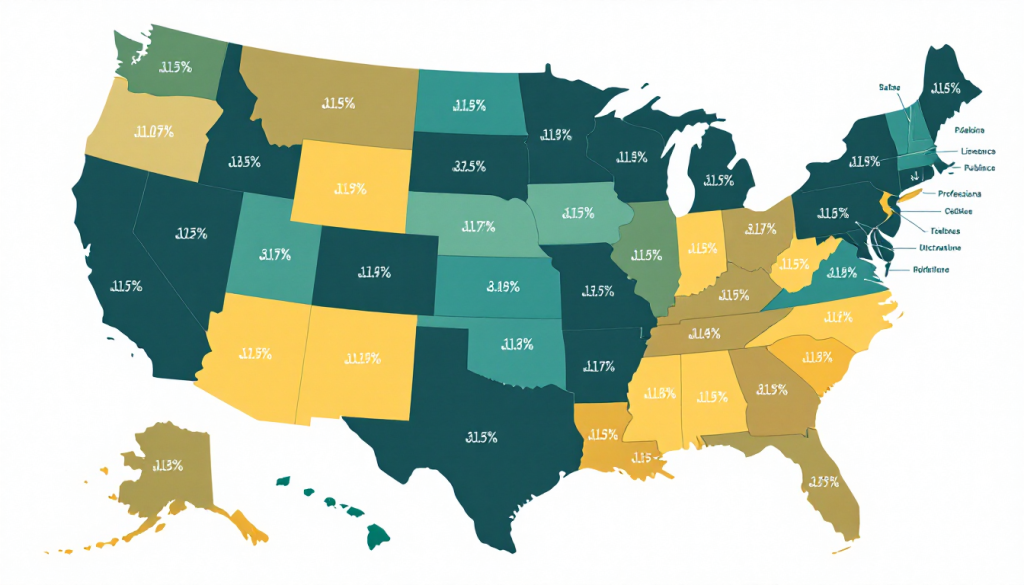
CPA licensure requirements by state are changing faster than at any point in 25 years, and this is a living tracker of where every jurisdiction stands. It covers all 55 NASBA jurisdictions (50 states plus the District of Columbia, Guam, Puerto Rico, the U.S. Virgin Islands, and the Commonwealth of the Northern Mariana Islands), drawn from state boards of accountancy, the NASBA Accountancy Licensing Database, enacted legislation, and the Minnesota Society of CPAs national tracker. We update it as states legislate, typically within 30 days of a signed bill or adopted rule.
Headline findings
- As of June 2026, 42 of the 55 jurisdictions have enacted an alternative licensure pathway (signed bill or adopted board rule), per the Minnesota Society of CPAs national tracker. That is well past the “half the states” milestone and trending toward roughly 47 by year end.
- The door opened on May 14, 2025, when the AICPA and NASBA boards approved an amended Uniform Accountancy Act (the Ninth Edition, published July 2025) adding a third licensure path, per the Journal of Accountancy and NASBA.
- The dominant new structure is a bachelor’s degree (120 semester hours) plus two years of documented experience plus passing the CPA Exam, sitting alongside the traditional 150-hour path and a graduate-degree-plus-one-year path, per the AICPA-NASBA model legislation.
- The mobility question is the live risk: NASBA’s December 2025 guidance confirms the model law shifts practice privileges from state-based “substantial equivalency” to an individual-based system, so a 120-hour licensee’s right to work across state lines now depends on their own credentials, not their home state’s rules.
- The driver is supply. NASBA’s 2024 Candidate Performance Report counted 74,165 candidates sitting for the Exam in 2024, with new-candidate volume still well below the 2016 peak, the shortfall that pushed boards to lower the credit-hour hurdle.
- Only a handful of jurisdictions (Maine, North Dakota, Wyoming, and several territories) have no enacted or pending bill as of this update, per the Minnesota Society of CPAs tracker.
Scope and methodology
This tracker covers all 55 NASBA jurisdictions: the 50 states, the District of Columbia, Guam, Puerto Rico, the U.S. Virgin Islands, and the Commonwealth of the Northern Mariana Islands (CNMI). For each jurisdiction we track six fields: the current education requirement, the alternative pathway status (enacted, pending, or none), the pathway structure, the effective date, the bill number or rulemaking authority, and the source.
Our sources are the state boards of accountancy, the NASBA Accountancy Licensing Database and Uniform Accountancy Act (UAA), enacted state bills cited by number, the Minnesota Society of CPAs broadening-pathways national tracker (the most-cited running tally), and reporting from Accounting Today, CFO Dive, and the Journal of Accountancy. Where a NASBA or state-board source conflicts with secondary reporting, we defer to the state board or the Minnesota Society of CPAs tracker and flag the discrepancy.
Update cadence: within 30 days of a signed bill or adopted rule. Limitations: this area moves quickly, and a signed bill is not always immediately operative. Several states enacted enabling legislation in 2025 or 2026 with effective dates that depend on subsequent board rulemaking, so an “enacted” entry does not guarantee a candidate can use the new path today. Effective dates marked “pending rulemaking” or “verify” carry that caveat. Citation policy: every state entry below is tied to a bill number, a rulemaking action, or a named board publication; anything we cannot confirm is marked “verify” rather than asserted.
The national picture: how the 150-hour rule is being rolled back
For roughly 25 years, 150 semester hours of education was the de facto national standard for CPA licensure. Florida adopted the first 150-hour rule in 1983, and by the mid-2000s nearly every jurisdiction had followed, anchoring the requirement in the Uniform Accountancy Act maintained jointly by the AICPA and NASBA. The extra 30 hours beyond a standard 120-hour bachelor’s degree became the single most-debated barrier to entry in the profession.
The reversal came in two steps. First, on May 14, 2025, the boards of directors of the AICPA and NASBA approved an expansion of the model legislation to add a third licensure path, per the Journal of Accountancy and NASBA. That path requires a bachelor’s degree (120 hours) plus two years of professional experience plus a passing CPA Exam score. Second, NASBA and the AICPA published the Ninth Edition of the UAA in July 2025, embedding the new path and the individual-based mobility framework into the model law, per NASBA. Because the UAA is a model and not binding, each jurisdiction still has to enact its own statute or adopt board rules before candidates can use the path.
States moved fast. The Minnesota Society of CPAs national tracker shows 42 of 55 jurisdictions had enacted an alternative pathway by June 2026, with several more pending. Minnesota itself was an early mover: Governor Tim Walz signed SF 3045 on May 23, 2025, creating a bachelor’s-plus-two-years path and a master’s-plus-one-year path, per CFO Dive and the Minnesota Society of CPAs.
The driver is the talent pipeline. NASBA’s 2024 Candidate Performance Report recorded 74,165 candidates sitting for the Exam in 2024, including 27,994 new candidates, with only 13,070 completing their final section, volumes that remain depressed against the profession’s mid-2010s peak. We track the supply side in depth in the Ledgerism 2026 Accounting Talent Pipeline Report and maintain a focused companion piece at 38 states and the 150-hour rollback.
Why did the 150-hour rule become the target rather than the Exam itself or the experience requirement? Two reasons recur in the legislative record. First, the fifth year of education carried a direct cost (tuition plus a delayed start to a paying career) without a clear corresponding gain in candidate quality, an argument advanced by state societies in testimony across multiple 2025 sessions and summarized by CFO Dive. Second, the 150-hour rule disproportionately deterred first-generation and lower-income students, narrowing the pipeline at the exact moment firms reported the sharpest staffing shortfalls in decades. The alternative-pathway model answers both by substituting documented work experience for the extra 30 credit hours, keeping the Exam and the experience requirement intact while removing the credit-hour barrier.
It is worth being precise about what the rollback is and is not. It is not the elimination of education standards: every enacted pathway still requires at least a bachelor’s degree with an accounting concentration and a passing score on all sections of the CPA Exam. It is not a reduction in the Exam. And in most states the 150-hour path remains available alongside the new options, so candidates who already hold a master’s degree or who plan one are not disadvantaged. Minnesota’s SF 3045 is a notable structural outlier: per the Minnesota Society of CPAs, it sunsets the standalone 150-hour rule after June 30, 2030, meaning Minnesota is moving toward making the experience-based pathways the default rather than an alternative. Most other states have layered the new path on top of the existing one rather than replacing it.
The full state-by-state tracker
This is the centerpiece: every one of the 55 NASBA jurisdictions, with its current requirement, alternative pathway status, structure, effective date, governing bill or rule, and source. Status labels are “150 hours (traditional only),” “Alternative enacted,” “Pending legislation,” or “No action.” Where a state enacted enabling legislation but the operative date depends on board rulemaking, the effective date column says so. Entries we could not independently confirm are marked “verify.”
How to read the structure column: “Bachelor’s + 2 yrs” means a 120-hour bachelor’s degree with an accounting concentration plus two years of qualifying experience plus a passing CPA Exam, the core new pathway from the AICPA-NASBA model legislation. “Master’s + 1 yr” means a graduate degree in accounting plus one year of experience plus the Exam. A few states (New Mexico, Oregon, Indiana) added a third hybrid variant, such as 150 hours plus one year or a bachelor’s plus 30 hours plus one year, which we note in the structure column. In nearly every enacted state the traditional 150-hour path remains available; the new structures are additive unless the entry indicates otherwise.
A note on the most-cited anchor states. Ohio’s HB 238, signed January 8, 2025 and operative January 1, 2026, is widely treated as the template: bachelor’s plus two years or master’s plus one year, with the Exam unchanged, per Accounting Today and the Ohio Society of CPAs. Georgia (HB 148), Virginia (HB 2042/SB 1042), New Mexico (HB 296), North Carolina (SB 321), Oregon (SB 797), Tennessee (HB 1330), and Minnesota (SF 3045) also went live on or around January 1, 2026, the largest single effective-date cluster, per the Going Concern roundup. Utah (SB 15) and Iowa (HF 778) follow with mid-2026 effective dates (July 1, 2026), and Illinois (HB 2459), Indiana (HB 1143), and California (AB 1175) land in 2027. Texas enacted two bills (SB 262 and SB 522) in May 2025 to add the experience-based path and align mobility. Where a secondary source reported a different bill number or date than the state board or the Minnesota Society of CPAs tracker, we used the board and the tracker as the controlling sources.
| Jurisdiction | Current Requirement | Alternative Pathway | Pathway Structure | Effective Date | Bill / Authority | Source |
|---|---|---|---|---|---|---|
| Alabama | 150 hours | Enacted | Bachelor’s + 2 yrs OR master’s + 1 yr | Per board rulemaking | HB 59 (signed 1/30/2026) | MNCPA tracker; AL State Board |
| Alaska | 150 hours | Enacted | Bachelor’s + 2 yrs experience | Effective 7/23/2025; live 1/1/2026 | HB 121 | MNCPA tracker; Going Concern |
| Arizona | 150 hours | Enacted | Bachelor’s + 2 yrs OR master’s + 1 yr | Per board rulemaking | SB 1181 (signed 4/7/2026) | MNCPA tracker; AZ State Board |
| Arkansas | 150 hours | Enacted (rule) | Bachelor’s + 2 yrs experience | Rules approved 2/23/2026 | Board rule change | MNCPA tracker; AR State Board |
| California | 150 hours | Enacted | Bachelor’s concentration + 2 yrs OR master’s + 1 yr | Per board rulemaking (est. 2027) | AB 1175 (signed 10/3/2025) | MNCPA tracker; CA Board of Accountancy |
| Colorado | 150 hours | Enacted | Bachelor’s + 2 yrs OR master’s + 1 yr | Per board rulemaking | SB 26-076 (signed 5/4/2026) | MNCPA tracker; COCPA |
| Connecticut | 150 hours | Enacted | Bachelor’s + 2 yrs OR master’s + 1 yr | Per board rulemaking | HB 7020 (signed 6/10/2025) | MNCPA tracker; CT State Board |
| Delaware | 150 hours | Enacted | Bachelor’s + 2 yrs experience | Per board rulemaking | HB 143 / HS 1 (signed 7/30/2025) | MNCPA tracker; DE Board of Accountancy |
| District of Columbia | 150 hours | Pending legislation | Proposed bachelor’s + 2 yrs path | Pending | B26-0494 (introduced) | MNCPA tracker; DC Board of Accountancy |
| Florida | 150 hours (traditional only) | Pending (bill failed 2026 session) | Proposed multi-path; not enacted | None; reintroduction expected | 2026 bill failed | MNCPA tracker; FL Board of Accountancy |
| Georgia | 150 hours | Enacted | Bachelor’s accounting + 2 yrs OR master’s + 1 yr | 1/1/2026 | HB 148 (signed 5/19/2025) | MNCPA tracker; Georgia Society of CPAs |
| Guam | 150 hours | No action (rules update underway) | None enacted; board updating rules | Verify | Board rulemaking pending | MNCPA tracker; Guam Board |
| Hawaii | 150 hours | Enacted | Bachelor’s + 2 yrs OR master’s + 1 yr | Per board rulemaking | SB 1291 SD1 (signed 4/10/2025) | MNCPA tracker; HI Board of Accountancy |
| Idaho | 150 hours | Enacted | Bachelor’s + 2 yrs OR master’s + 1 yr | Per board rulemaking | HB 563 (signed 3/18/2026) | MNCPA tracker; ID Board of Accountancy |
| Illinois | 150 hours | Enacted | Bachelor’s 120 hrs + 2 yrs OR master’s + 1 yr | 1/1/2027 | HB 2459 (signed 8/15/2025) | MNCPA tracker; Illinois CPA Society |
| Indiana | 150 hours | Enacted | Bachelor’s + 2 yrs OR 150 hrs + 1 yr OR master’s + 1 yr | 1/1/2027 (per rulemaking) | HB 1143 (signed 4/16/2025) | MNCPA tracker; IN Board of Accountancy |
| Iowa | 150 hours | Enacted | Bachelor’s + 2 yrs experience | 7/1/2026 | HF 778 (signed 5/1/2025) | MNCPA tracker; Iowa Society of CPAs |
| Kansas | 150 hours | Enacted | Bachelor’s + 2 yrs OR master’s + 1 yr | Per board rulemaking | HB 2573 (signed 4/9/2026) | MNCPA tracker; KS Board of Accountancy |
| Kentucky | 150 hours | Enacted | Bachelor’s + 2 yrs OR master’s + 1 yr | Per board rulemaking | HB 45 (signed 4/3/2026) | MNCPA tracker; KY Board of Accountancy |
| Louisiana | 150 hours | Enacted | Bachelor’s + 2 yrs OR master’s + 1 yr | Per board rulemaking | HB 548 (signed 6/2/2026) | MNCPA tracker; Society of LA CPAs |
| Maine | 150 hours (traditional only) | No action (submission expected Dec 2026) | None enacted | None | Legislation expected 2026 to 2027 | MNCPA tracker; ME Board of Accountancy |
| Maryland | 150 hours | Enacted | Bachelor’s + 2 yrs OR master’s + 1 yr | Per board rulemaking | HB 643 (signed 4/28/2026) | MNCPA tracker; MD Board of Accountancy |
| Massachusetts | 150 hours (traditional only) | Pending legislation | Proposed multi-path | Pending | S.2946 (passed Senate) | MNCPA tracker; Mass. Society of CPAs |
| Michigan | 150 hours (traditional only) | Pending legislation | Proposed multi-path | Pending | HB 4893 (passed House) | MNCPA tracker; MICPA |
| Minnesota | 150 hours | Enacted | Bachelor’s + 2 yrs OR master’s + 1 yr; sunsets 150-hr path 6/30/2030 | 1/1/2026 | SF 3045 (signed 5/23/2025) | Minnesota Society of CPAs; CFO Dive |
| Mississippi | 150 hours | Enacted | Bachelor’s + 2 yrs OR master’s + 1 yr | Per board rulemaking | HB 1137 (signed 3/13/2026) | MNCPA tracker; MS Board of Accountancy |
| Missouri | 150 hours (traditional only) | Pending (awaiting signature) | Proposed multi-path | Pending | SB 1233 (awaits governor) | MNCPA tracker; Missouri Society of CPAs |
| Montana | 150 hours | No action (rules change expected) | Board rule change anticipated | Verify | Board rulemaking pending | MNCPA tracker; MT Board of Public Accountants |
| Nebraska | 150 hours | Enacted | Bachelor’s + 2 yrs OR master’s + 1 yr | Per board rulemaking | LB 718 (signed 2/25/2026) | MNCPA tracker; NE Board of Public Accountancy |
| Nevada | 150 hours | Enacted | Bachelor’s + 2 yrs OR master’s + 1 yr | Per board rulemaking | AB 510 (signed 5/26/2025) | MNCPA tracker; NV State Board of Accountancy |
| New Hampshire | 150 hours | Enacted | Bachelor’s + 2 yrs OR master’s + 1 yr | Per board rulemaking | HB 1259 (signed 4/22/2026) | MNCPA tracker; NH Board of Accountancy |
| New Jersey | 150 hours | Enacted | Bachelor’s + 2 yrs OR master’s + 1 yr | Per board rulemaking | A5598 (signed 1/12/2026) | MNCPA tracker; NJCPA |
| New Mexico | 150 hours | Enacted | Bachelor’s + 2 yrs OR master’s + 1 yr OR bachelor’s + 30 hrs + 1 yr | 1/1/2026 | HB 296 (signed 4/8/2025) | MNCPA tracker; NM Public Accountancy Board |
| New York | 150 hours | Enacted | Bachelor’s + 2 yrs added path; stricter course rules effective 8/1/2027 | Per board rulemaking | AB 7613 (signed 11/21/2025) | MNCPA tracker; NYSSCPA; NY State Education Dept |
| North Carolina | 150 hours | Enacted | Bachelor’s accounting + 2 yrs experience | 1/1/2026 | SB 321 (signed 7/1/2025) | MNCPA tracker; NC State Board of CPA Examiners |
| North Dakota | 150 hours (traditional only) | No action (2027 legislation planned) | None enacted | None | Legislation planned 2027 | MNCPA tracker; ND State Board of Accountancy |
| Northern Mariana Islands (CNMI) | 150 hours | No action (verify) | None enacted; status unconfirmed | Verify | Verify | NASBA; CNMI Board of Accountancy |
| Ohio | 150 hours | Enacted | Bachelor’s 120 hrs + 2 yrs OR master’s + 1 yr | 1/1/2026 | HB 238 (signed 1/8/2025) | MNCPA tracker; Accounting Today; Ohio Society of CPAs |
| Oklahoma | 150 hours | Enacted | Bachelor’s + 2 yrs OR master’s + 1 yr | Per board rulemaking | HB 4317 (signed 5/6/2026) | MNCPA tracker; OK Accountancy Board |
| Oregon | 150 hours | Enacted | Bachelor’s + 2 yrs OR master’s + 1 yr OR 150 hrs + 1 yr | 1/1/2026 | SB 797 (signed 5/22/2025) | MNCPA tracker; Oregon Board of Accountancy |
| Pennsylvania | 150 hours | Enacted | 120 credits + 2 yrs experience | Per board rulemaking | SB 719 (signed 6/30/2025) | MNCPA tracker; PICPA |
| Puerto Rico | 150 hours | Enacted | Bachelor’s + 2 yrs OR master’s + 1 yr | Per board rulemaking | Ley 174-2025 (signed 12/19/2025) | MNCPA tracker; PR Board of Accountancy |
| Rhode Island | 150 hours (traditional only) | Pending (awaiting signature) | Proposed multi-path | Pending | H 8128 (awaits governor) | MNCPA tracker; RI Board of Accountancy |
| South Carolina | 150 hours | Enacted | Bachelor’s + 2 yrs OR master’s + 1 yr | Per board rulemaking | SB 176 (signed 5/12/2025) | MNCPA tracker; SC Board of Accountancy |
| South Dakota | 150 hours | Enacted | Bachelor’s + 2 yrs OR master’s + 1 yr | Per board rulemaking | HB 1035 (signed 3/2/2026) | MNCPA tracker; SD Board of Accountancy |
| Tennessee | 150 hours | Enacted | Bachelor’s + 2 yrs OR master’s + 1 yr | 1/1/2026 | HB 1330 (signed 5/21/2025) | MNCPA tracker; Tennessee Society of CPAs |
| Texas | 150 hours | Enacted | Bachelor’s + 2 yrs experience added path | Per board rulemaking (est. 9/2025 onward) | SB 262 & SB 522 (signed 5/8 & 5/19/2025) | MNCPA tracker; TXCPA; Texas State Board |
| Utah | 150 hours | Enacted | Bachelor’s concentration + 2 yrs OR master’s + 1 yr | 7/1/2026 | SB 15 (signed 3/25/2025) | MNCPA tracker; UACPA |
| Vermont | 150 hours | Enacted | Bachelor’s + 2 yrs OR master’s + 1 yr | Per board rulemaking | H.588 (signed 6/8/2026) | MNCPA tracker; VT Board of Public Accountancy |
| Virginia | 150 hours | Enacted | Bachelor’s + 2 yrs OR master’s + 1 yr | 1/1/2026 | HB 2042 / SB 1042 (signed 3/24/2025) | MNCPA tracker; Virginia Society of CPAs |
| Washington | 150 hours | Enacted (rule) | Bachelor’s + 2 yrs OR master’s + 1 yr | Rules adopted 10/17/2025 | Board rule adoption | MNCPA tracker; WA State Board of Accountancy |
| West Virginia | 150 hours | Enacted | Bachelor’s + 2 yrs OR master’s + 1 yr | Per board rulemaking | HB 4088 (signed 3/2/2026) | MNCPA tracker; WV Board of Accountancy |
| Wisconsin | 150 hours | Enacted | Bachelor’s + 2 yrs OR master’s + 1 yr | Per board rulemaking | AB 696 (signed 4/2/2026) | MNCPA tracker; WICPA |
| Wyoming | 150 hours (traditional only) | No action (2027 legislation planned) | None enacted | None | Legislation planned 2027 | MNCPA tracker; WY Board of CPAs |
| U.S. Virgin Islands | 150 hours | No action (rules update underway) | None enacted; board updating rules | Verify | Board rulemaking pending | MNCPA tracker; USVI Board of Accountancy |
Note on counts: the table above lists 55 jurisdictions. Of these, 42 have enacted an alternative pathway (signed bill or adopted board rule), 6 have pending legislation (District of Columbia, Florida, Massachusetts, Michigan, Missouri, Rhode Island), and the remainder (Maine, Montana, North Dakota, Wyoming, Guam, U.S. Virgin Islands, CNMI) have no enacted pathway, with several planning future action. Tally per the Minnesota Society of CPAs national tracker as of June 2026. Effective dates marked “per board rulemaking” mean the enabling statute is signed but candidate access depends on the state board completing rules; confirm the operative date with the relevant state board before relying on it.
The mobility problem
The hardest question this rollback creates is cross-jurisdiction practice. Historically, CPA mobility ran on “substantial equivalency” under Section 23 of the Uniform Accountancy Act: a CPA from State A could practice in State B without a second license as long as State A’s overall requirements (including the 150-hour rule) were deemed substantially equivalent to State B’s. That state-to-state comparison worked when nearly every jurisdiction required 150 hours. It breaks down the moment one state licenses a CPA at 120 hours plus experience and another still requires 150.
The concern is concrete: if a CPA is licensed under Ohio’s 120-hour pathway (HB 238, effective January 1, 2026), can that person sign off on work or practice in a state that still anchors its rules to 150 hours? Under the old substantial-equivalency model, the answer could be uncertain, because the home-state requirement might no longer match.
NASBA and the AICPA addressed this directly in the Ninth Edition of the UAA. Per NASBA’s December 2025 guidance, the model law shifts mobility from a state-based system to an individual-based system. A CPA’s ability to practice across state lines is now determined by their personal qualifications (education, exam, and experience) rather than whether their home state holds “substantial equivalency.” The intent is automatic individual mobility: a properly licensed CPA carries practice privileges with them regardless of which of the three model pathways they used.
Two caveats keep this from being settled. First, mobility only works where both the home and the visited jurisdiction have adopted the individual-based language; adoption is uneven and implementation dates vary, per NASBA. Second, a handful of jurisdictions have not yet enacted any change, so a 120-hour licensee visiting a traditional-only state should confirm reciprocity with that state’s board rather than assume coverage. NASBA directs practitioners to CPAMobility.org and its licensure-pathways page for jurisdiction-specific rules. We track this against the NASBA UAA Model Rules and update the matrix above as states align their mobility statutes.
The transition period is the real exposure window. Between the early-2025 wave of signings and the point at which every jurisdiction has both enacted the pathway and adopted the individual-mobility language, there will be a stretch where a CPA licensed under a 120-hour path holds clear privileges in some states and uncertain privileges in others. The states that have not yet acted (Maine, North Dakota, Wyoming, and the territories per the Minnesota Society of CPAs tracker) are where a traveling 120-hour licensee should be most careful, because a board there may still evaluate practice privileges against a 150-hour benchmark. For firms operating in multiple states, the practical safeguard is to map each engagement to the destination state’s current mobility posture rather than relying on a blanket assumption that a CPA credential travels everywhere.
NASBA’s individual-based model is designed to make this exposure temporary. As more states adopt the Ninth Edition language, the relevant test stops being “is the home state substantially equivalent” and becomes “does this individual hold a degree, a passing Exam, and the required experience,” a question that does not change when the CPA crosses a state line. The direction of travel is clear, but until adoption is universal the prudent posture is to verify, which is exactly what the source links in the matrix above are for.
CPA exam pass rates by section
The CPA Exam moved to the CPA Evolution format in January 2024, replacing the prior four-part structure with three Core sections (AUD, FAR, REG) plus one of three Discipline sections (BAR, ISC, TCP). The table below shows national pass rates for the 2024 and 2025 calendar years, with the most recent quarter where available, per NASBA Candidate Performance Reports and aggregated section reporting.
| Section | Type | 2024 Pass Rate | 2025 Pass Rate | Most Recent (Q1 2026) |
|---|---|---|---|---|
| AUD (Auditing and Attestation) | Core | 46% | 48% | 48% |
| FAR (Financial Accounting and Reporting) | Core | 40% | 42% | Verify |
| REG (Taxation and Regulation) | Core | 63% | 63% | 67% |
| BAR (Business Analysis and Reporting) | Discipline | 38% | 42% | Verify |
| ISC (Information Systems and Control) | Discipline | 58% | 68% | Verify |
| TCP (Tax Compliance and Planning) | Discipline | 74% | 78% | 79% |
Source: NASBA Candidate Performance Reports and aggregated section pass-rate reporting. Rates are national; “Most Recent” reflects Q1 2026 where published, marked “verify” where a single-quarter figure was not separately confirmed. NASBA attributes the 2025 improvement to better-prepared candidates and normalizing volumes rather than a change in exam difficulty. NASBA’s 2024 report also publishes jurisdiction-level rankings: Nebraska led at 61.9%, followed by Utah at 58.6% and Montana at 57.4%, with 74,165 total candidates sitting in 2024.
Two things stand out in the pass-rate data for anyone weighing a discipline choice. First, the spread across Discipline sections is wide: TCP candidates passed at 78% in 2025 while BAR candidates passed at 42%, per the aggregated reporting, a 36-point gap that reflects both candidate self-selection and section difficulty. Second, the Core sections that historically gate the most candidates, FAR at 42% and AUD at 48% in 2025, remain the slowest movers, which is consistent with NASBA’s framing that the recent improvement reflects preparation rather than an easier Exam. We connect these completion dynamics to firm hiring in the 2026 Accounting Talent Pipeline Report, because the number of candidates who finish all four required sections (13,070 in 2024 per NASBA) is the figure that ultimately feeds the licensed-CPA supply, not the number who merely sit.
What the data shows: the patchwork emerging
Three buckets describe the map. The first, by far the largest, is the enacted bucket: 42 jurisdictions have signed a bill or adopted a rule creating an alternative path, per the Minnesota Society of CPAs tracker. The second is the pending bucket: 6 jurisdictions (District of Columbia, Florida, Massachusetts, Michigan, Missouri, Rhode Island) have bills moving but not yet law, with Florida’s 2026 attempt having failed and reintroduction expected. The third is the no-action bucket: Maine, North Dakota, Wyoming, and the territories of Guam, the U.S. Virgin Islands, and CNMI, several of which have signaled 2027 legislation or pending board rules.
There is mild regional clustering, but the more striking pattern is how broad and fast adoption has been across every region, from early movers like Ohio, Virginia, Georgia, and Minnesota in early 2025 to a second wave (Alabama, Arizona, Wisconsin, Idaho, Mississippi, and others) signing in the first half of 2026. Most operative effective dates fall in the 2026 to 2027 window, with the largest single cluster going live on January 1, 2026 (including Georgia, Minnesota, New Mexico, North Carolina, Ohio, Oregon, Tennessee, and Virginia per the Going Concern roundup), and California, Illinois, and Indiana landing in 2027.
For employers, the practical implication is that cross-state hiring now requires checking the candidate’s licensing pathway and the destination state’s mobility posture, not just confirming a CPA credential. For candidates, state choice matters more than it has in a generation: the credit-hour cost of entry now varies by jurisdiction, and a 120-hour path plus two years of experience can be materially cheaper than a fifth year of school. We expand on the firm-side implications in our guide on how to start a CPA firm.
The timing data also tells a story about momentum. The first cluster of signings came in spring 2025 (Ohio in January, then Virginia, Utah, New Mexico, Indiana, Georgia, Nevada, Oregon, Tennessee, Texas, Minnesota, and others through May and June), per the Minnesota Society of CPAs tracker. A second, even broader wave arrived in the first half of 2026, with Alabama, Arizona, Wisconsin, Idaho, Mississippi, South Dakota, West Virginia, Nebraska, Kansas, Kentucky, Maryland, New Hampshire, Oklahoma, Colorado, Louisiana, and Vermont all signing alternative-pathway legislation. That acceleration is why the count moved from a handful of states in early 2025 to 42 jurisdictions by mid-2026, and why the Minnesota Society of CPAs and CFO Dive both project roughly 47 jurisdictions with enacted pathways by the end of 2026.
One pattern worth flagging for candidates and recruiters: the gap between “signed” and “usable.” Many 2026 signings left the operative mechanics to board rulemaking, so a state can appear as “enacted” in the matrix while its candidates still cannot file under the new path until the board finalizes rules. That is why a large share of effective dates in the matrix read “per board rulemaking” rather than a fixed calendar date. Anyone planning a licensure timeline around a specific state should confirm the board’s rulemaking status, not just the bill’s signing date.
What we are tracking next
Four threads. First, the pending-legislation states (District of Columbia, Massachusetts, Michigan, Missouri, Rhode Island) and Florida’s expected reintroduction; we will move these to “enacted” within 30 days of a signed bill. Second, the 2026 to 2027 legislative sessions in Maine, North Dakota, and Wyoming, the remaining traditional-only states. Third, board rulemaking that converts “signed but pending rules” entries into live, candidate-usable pathways, the gap that currently sits behind many “per board rulemaking” effective dates. Fourth, any further NASBA UAA amendments and the next NASBA Candidate Performance Report, which will give us full-year 2025 and 2026 section pass rates to replace the quarter-level figures marked “verify” above.
Methodology and limitations
Sources are state boards of accountancy, the NASBA Accountancy Licensing Database and Uniform Accountancy Act, enacted state bills cited by number, the Minnesota Society of CPAs broadening-pathways national tracker, and reporting from Accounting Today, CFO Dive, and the Journal of Accountancy. We update within 30 days of a signed bill or adopted rule.
Limitations are real. Legislation in this area moves quickly, and bill numbers, signing dates, and effective dates are sometimes reported inconsistently across secondary sources; where we found conflicts (for example, differing reported effective dates for Ohio’s HB 238 or differing bill numbers for Iowa and Virginia), we deferred to the Minnesota Society of CPAs tracker and the relevant state board, and we flagged the structure rather than overstate a single date. A signed statute does not always mean a usable pathway: many states left the operative details to board rulemaking, so entries marked “per board rulemaking” require confirmation with the state board. Anything we could not independently confirm, including the precise status of CNMI and the timing of territorial rule updates, is marked “verify.” This is a tracker, not legal advice; candidates and firms should confirm current requirements with the relevant state board before acting.
How to cite this tracker
Cite as: The Ledgerism Brief, “State CPA Licensure Tracker,” ledgerism.net/state-cpa-licensure-tracker/, as of June 2026. For bulk data, the full machine-readable matrix, or a point-in-time snapshot for research or reporting, contact research@ledgerism.net. Related Ledgerism coverage: our research index, the 2026 Accounting Talent Pipeline Report, the 38-states 150-hour rollback brief, our CPAs section, and our regulatory coverage.
Bottom line
The 25-year era of the 150-hour rule as the single national standard for CPA licensure is ending. As of June 2026, 42 of the 55 NASBA jurisdictions have enacted an alternative pathway and more are pending, per the Minnesota Society of CPAs national tracker. This tracker is the canonical, sourced, state-by-state record of where each jurisdiction stands, and it is updated as states legislate.
Sources cited
NASBA Accountancy Licensing Database and Uniform Accountancy Act (Ninth Edition, published July 2025); AICPA-NASBA model legislation approving the additional licensure path (boards approved May 14, 2025; Journal of Accountancy, May 2025); NASBA, “New CPA Licensure Pathways and CPA Mobility” (December 2025); individual state boards of accountancy and enacted bills cited by number throughout the tracker (for example, Ohio HB 238, Georgia HB 148, Virginia HB 2042/SB 1042, Iowa HF 778, Minnesota SF 3045, Utah SB 15, Wisconsin AB 696); the Minnesota Society of CPAs broadening-pathways national tracker; NASBA 2024 Candidate Performance Report; and reporting from Accounting Today, CFO Dive, the Journal of Accountancy, and Going Concern.